
Discomfort and Growth
Pema Chödrön has long been a guiding light for me. Ezra Klein interviewed her for his podcast recently, and my husband recognized her voice immediately as the woman I play while doing yoga. I’ve listened to The Places that Scare You and When Things Fall Apart countless times, and I find wisdom in each repeat.
“The degree to which we can feel discomfort is the degree to which we can grow,” Pema Chödrön rephrasing a question by Ezra Klein.
I found particular comfort in an exchange between Chödrön and Klein about developing a tolerance for discomfort. While they had spoken about discomfort as physical pain, they were also describing the particular restlessness or even aversion one feels when pushing oneself to do something new or to feel something unwanted. In the realm of my work, doing something new and feeling something unwanted, e.g. frustration, can often go hand-in-hand.
This past winter I decided I wanted to learn Mokuhanga, a Japanese printmaking practice that uses woodblocks and water-based pigments. Mokuhanga is known to be difficult, particularly finicky due to its use of natural materials at almost every step. I decided to make it even more so by using botanical inks instead of the more common watercolor paints or sumi inks. Our high desert climate presents an additional challenge, as maintaining just the right level of dampness of the block, of the paper, of the ink, of the rice paste, and of the brushes is essential.
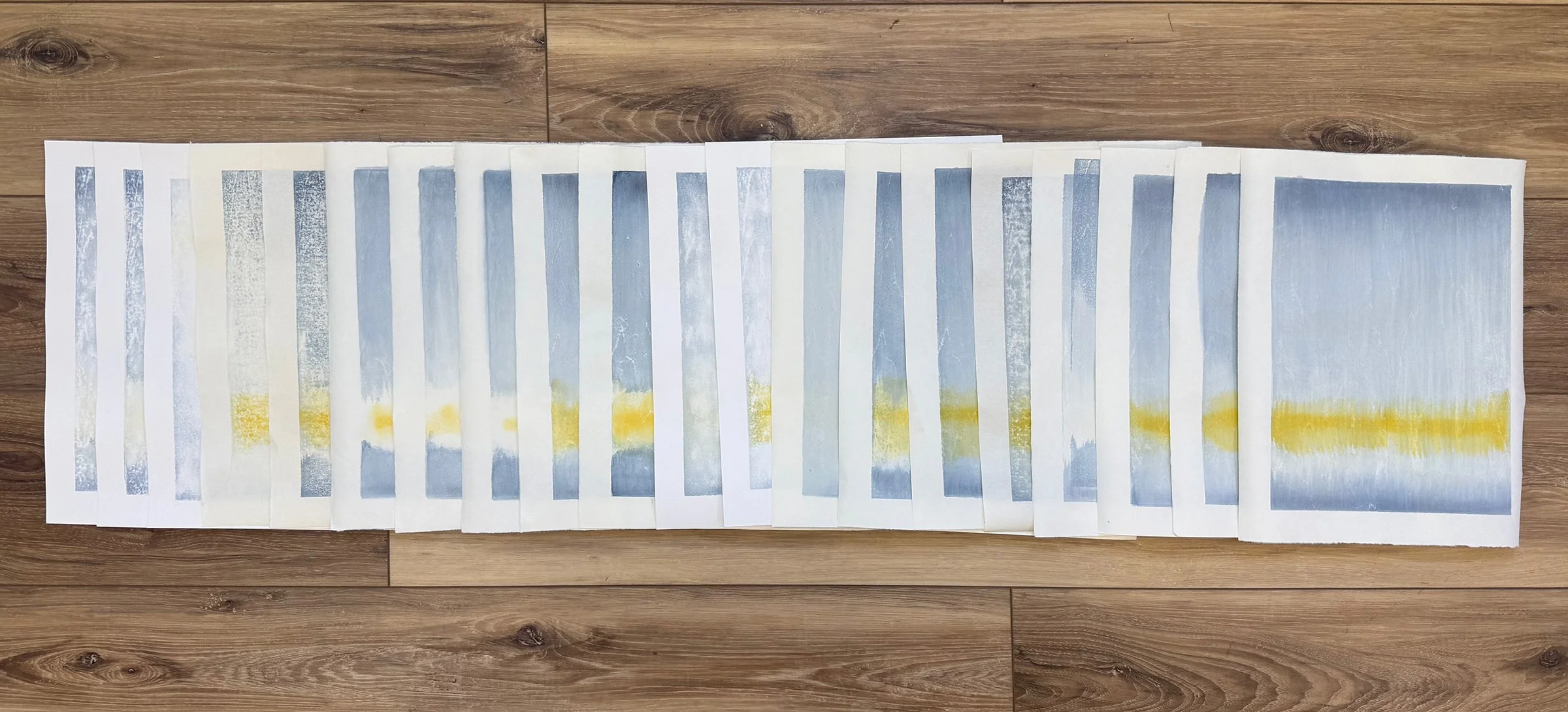
I’ve made 20+ prints so far, trying different papers and different damp pack strategies and different inking strategies and different registration methods…
As in all my work, it is the natural variability that draws me in. From discovering and sometimes enhancing the natural grain in a given woodblock to playing with the viscosity and opacity of an indigo versus a marigold ink, I’m enthralled by the potential of the interaction between a particular block and a particular ink (on a particular day—Mokuhanga is notoriously sensitive to atmospheric humidity). I think the tension between the reproducibility sought in many printmaking practices and the uniqueness of my Mokuhanga prints is part of their charm.
Embracing the variability from the start, I found myself frustrated still. The brushes used to spread ink on the woodblocks require conditioning before use. Learning to register paper precisely through multiple impressions on one print is an art in and of itself. I tried several combinations of wood and paper before capturing visible wood grain in my prints. Too much water on any one of the components of a print—woodblock, nori paste, ink, brushes, or paper—and you’ll get blooming or smearing. Too little water, and you’ll leave only a faint impression, or a splotchy excuse for one.
About five weeks ago, after a couple months of playing around with other designs, I had a vision of a print inspired by the prompt “Longing.” I set about making that print, one that would be larger and involve a bigger area of color than I had yet attempted. Also, I wanted a subtle gradation of color, called “bokashi” in Japanese. I wanted to print the entirety of one of my 9”x12” blocks. Doing so would require a registration board, a sort of jig for holding my block and aligning my paper for multiple impressions. I found a couple potential options online, but none seemed perfect and all were expensive. So I set about prototyping registration boards too.
Why do I go on about this? Sometimes I need to remind myself just what’s involved in making something I don’t know how to make. In retrospect, and often in accounts to friends and family, each step feels small and quick. (How did you spend your week again?) But in the doing each step takes its own time. And much progress is so incremental as to be visible only by me.
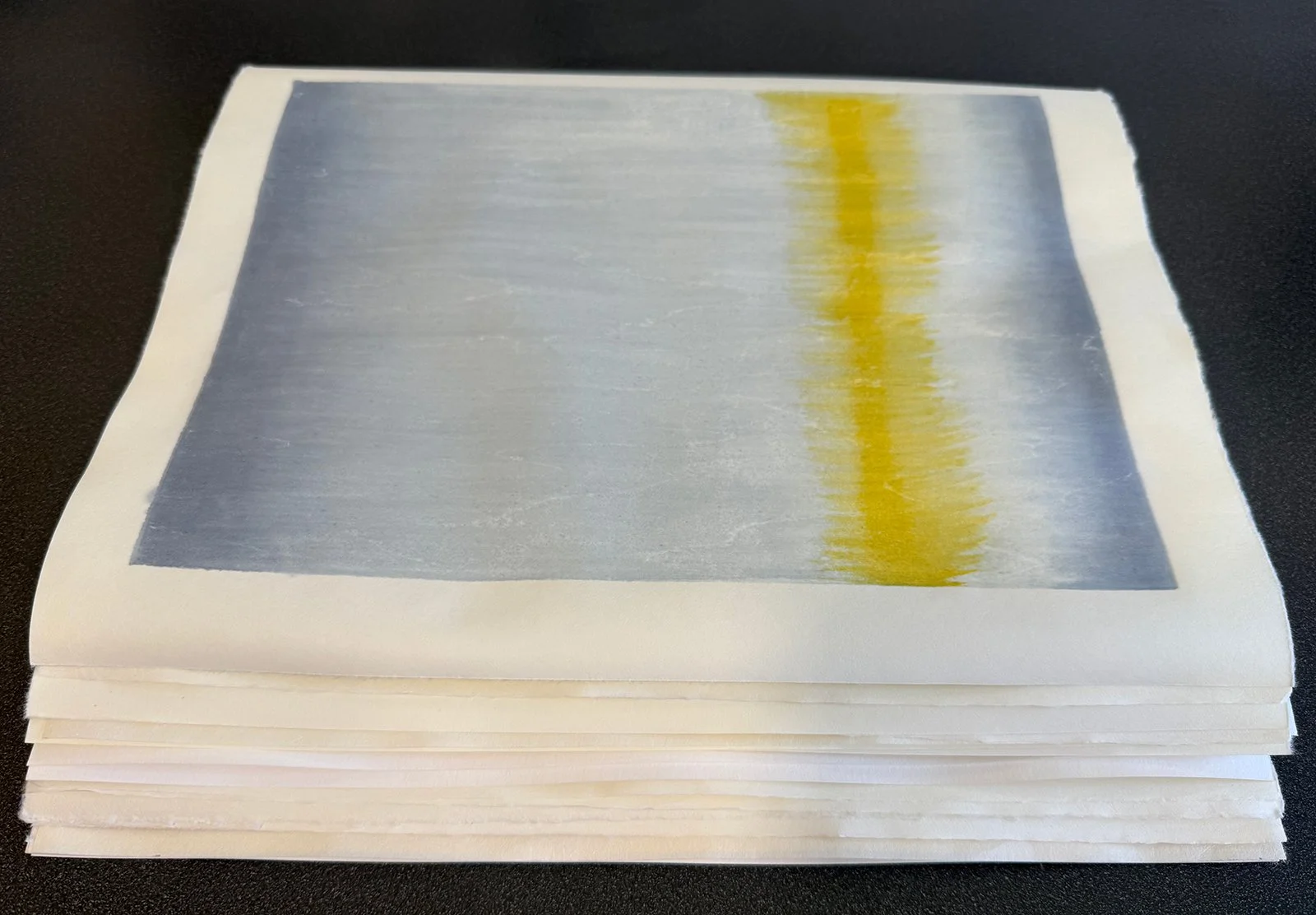
Failures stacked.
But, a little over a month in, I am making much better prints. Following three prototypes, I’ve had a local machine shop precision cut some pieces for a registration board that I’m excited about. I’m loving Awagami Shiramine Select paper, the eighth paper I tried. Sharp edges and pleasing bokashi in a print feel within reach. I am intentionally writing this before I arrive at final prints, as I’m uncertain when (if) that will occur. I’m working towards having a pair for an upcoming group show, but a deadline doesn’t the work make.
And this makes me so very uncomfortable. I hate missing deadlines. While I love learning new methods and modes, I must quiet an inner voice that argues I’m inept while doing so. As I “waste” ink and paper and time on unsuccessful prints, I have to remind myself to approach the next impression with the attention and focus of someone who believes the next impression might be the one. Or, more realistically, I have to approach each impression as if it’s one additional step towards developing a process that might one day yield satisfying prints. One can only hope…and keep printing.
This returns me to the Pema Chödrön quote. Every aspect of this process has involved discomfort. At each step I have met with repeated failure. The specter of not meeting a deadline floats in the near distance. While attempting a pigeon pose, my hips resist with all their stored angst, and I hear Pema remind me that this is what growth looks like.