
Thank You AD
I heard on All Things Considered yesterday that Annie Dillard had passed. I stood with dishes in my hands and cats yowling at my feet and listened to the radio tribute. Dillard is the first writer whose oeuvre I read in its entirety. I own three copies of Pilgrim at Tinker Creek, and my copy of An American Childhood has pages with annotations in three colors of ink--one of them neon!--and pencil. Like many who first encountered her work in college, she made me want to be a nature writer, whatever that means.
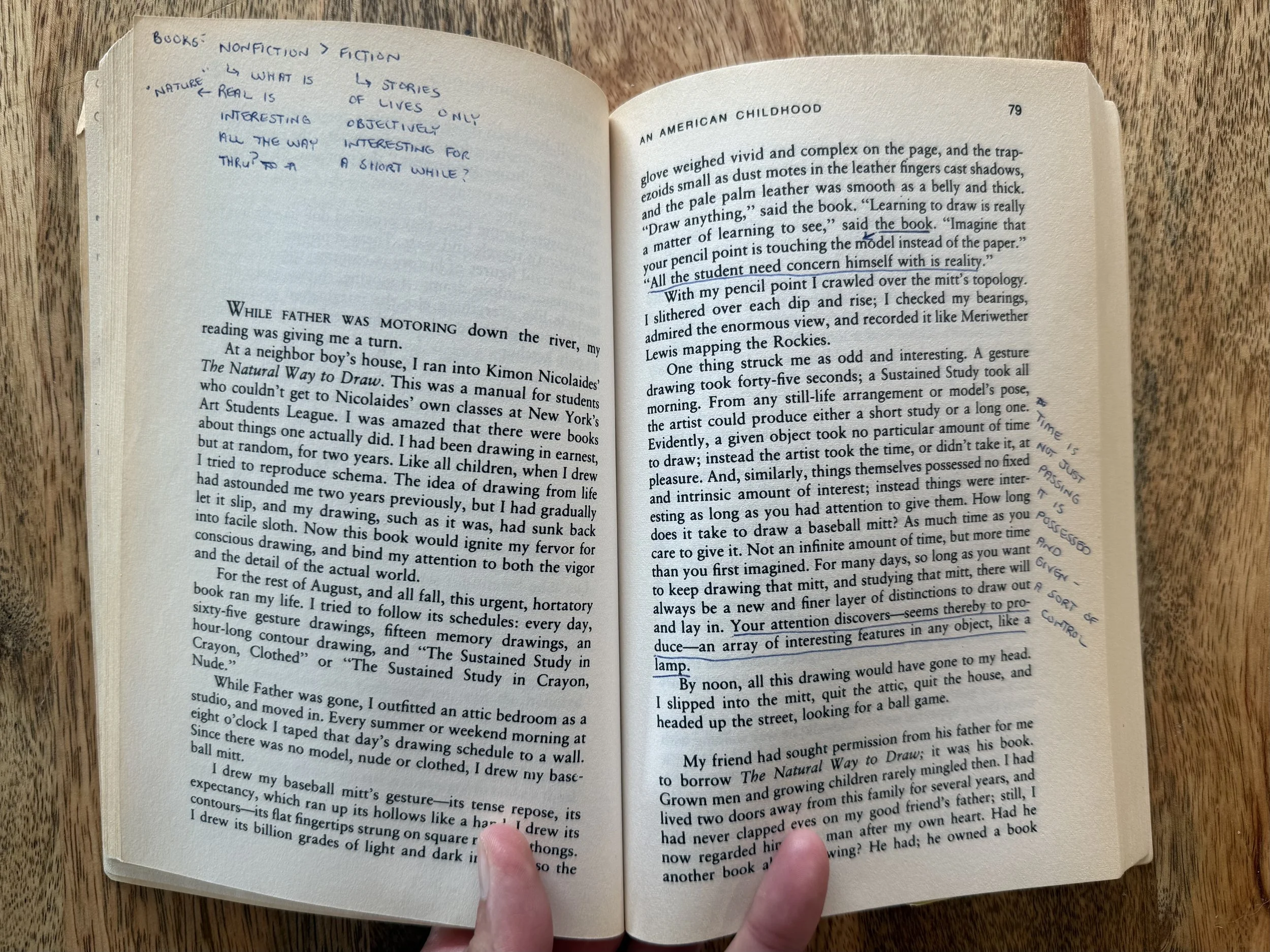
The annotations of a 20-year-old me on the pages of An American Childhood.
As a college junior, I wrote a thesis proposal outlining an argument about the relationship between the narrator, implied author, and the biographical author of Pilgrim at Tinker Creek. I was interested in the freedom we give writers of what I then thought of as "literaray nonfiction" to embellish events, or at least expand--or contract, in the case of Dillard--the facts to uncover a truth. I knew it was important to me that Dillard was a real person writing about her real life, and I knew I didn't care if she lived in a house with central air.
"What I have been after all along is not an explanation but a picture. This is the way the world is, altar and cup, lit by the fire from a star that has only begun to die." Annie Dillard, "Fecundity", Pilgrim at Tinker Creek
Now, as a 51 year-old woman, I see in her work an exquisite invitation to pay attention, even obsessively, to the natural world in both its beauty and its horror. I read in it a challenge to sit still and to listen and to watch and to feel. I see in her non-fiction a concern with truth, not necessarily the pedestrian details of one's life but the observational and spiritual revelations that arise when we (I) sit still and observe.
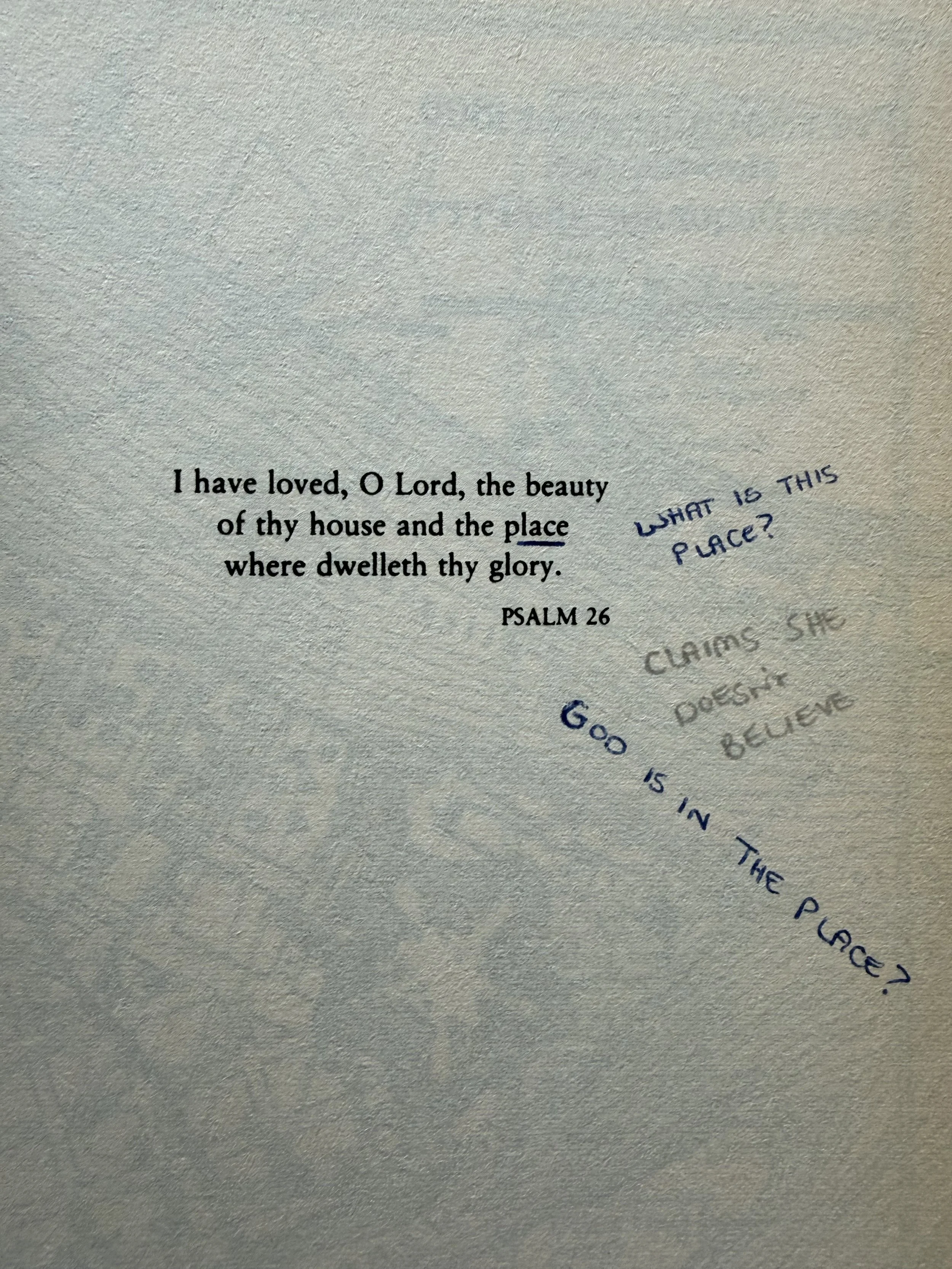
Epigraph and my annotations in my copy of Dillard’s An American Childhood. My handwriting is so neat!
Dillard had been largely and mysteriously silent for decades. I had long since stopped anticipating future volumes. Her passing is less a realization that there will be no more books than a feeling of an energetic void, a lack where there was once a presence. I took comfort in the knowledge that Dillard existed, perhaps I still imagined her in Virginia even though she had long since left the Blue Ridge, and yesterday that succor was spirited away.
As William Deresiewicz wrote in the Atlantic in 2016, Dillard "seems to know many little things—those myriad natural phenomena that she is so magnificent at seeing and describing—but in fact she knows one big thing. She knows that we are born with souls but die in bodies. That is a very big thing. It is the biggest thing."
Thank you, reader, for the virtual hug that is your reading of this post. I have been working intermittently on a long post about my summer trip through British Columbia and the Yukon Territory and (a bit of) Alaska. It's been a difficult thing to write because the adventure was so very bittersweet, as is much of my time spent in the outdoors these days. This brief revisiting of Dillard and my enduring relationship with her work feels like a gentle prod to push through the difficulties and simply do the work of writing.
Thank you Annie.